
Mutual Fund Trends: Your Practical Guide to Top Performance and SIP Strategy
Forget the financial jargon. Here is a simplified, honest look at trending mutual funds, managing real-world losses, and building a systematic investment plan that actually works.
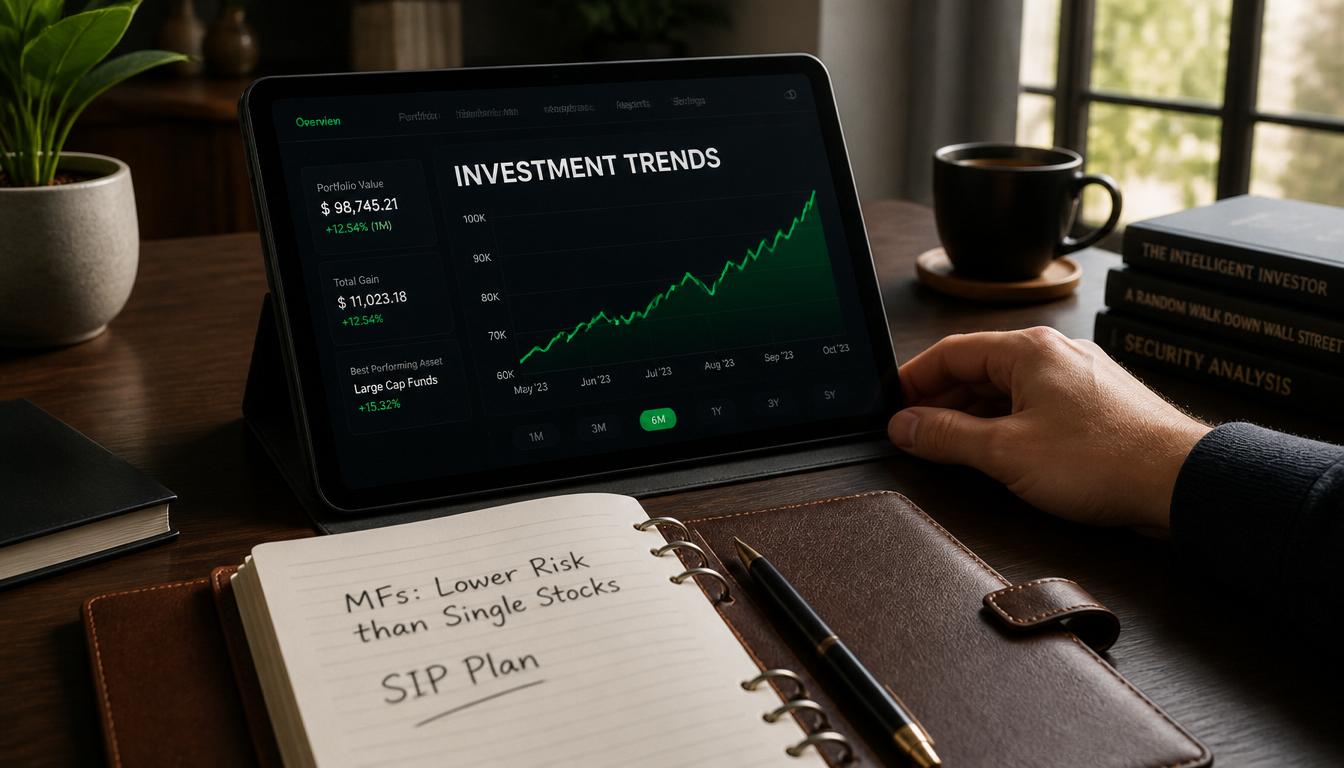
Let's be completely honest: the stock market looks incredibly easy when it's going up.
Every financial influencer on your feed makes it sound like you just pick three trending mutual funds, set up a Systematic Investment Plan (SIP), and watch your money double while you sleep. But if you’ve actually been putting your hard-earned money into the market over the last year, you know the reality is a lot more complicated.
Global events—like shifts in the US economy, rising interest rates, and unexpected international conflicts—ripple through the markets instantly. Suddenly, the funds that looked amazing a few months ago are sitting in the red, and your portfolio takes a hit.
If you are currently looking at your investment dashboard and seeing a loss, you aren't alone. But this is exactly where true investing begins.
Today, we are going to strip away the complex Wall Street jargon and look at a practical, real-world roadmap for mutual funds and SIPs. We will look at how the market works today, how to balance your risks, and how to build a portfolio that can survive global chaos.
1. A Reality Check: My Personal 1-Year Journey with SIPs and Stock Losses
Before we dive into the technical checklists, I want to share a personal story. I have been consistently investing via SIPs for over a year now, and to be completely brutally honest with you: it hasn't been a smooth, glorious ride.
When you start investing, you expect a clean, upward line. Instead, the real world hits. Over the last year, major global tensions, international wars, and shifting economic policies in the US sent shockwaves through global markets. Because our modern financial systems are completely interconnected, those overseas events dragged down local portfolios. For a while, I found myself sitting directly in a loss.
It's a frustrating feeling. You do everything "right," you invest systematically every month, and you still see negative numbers on your screen.
The Power of the "Safety Net" Allocation
However, because I didn't put all my eggs in one basket, I avoided a total disaster. Alongside my mutual funds, I had strategically spread my capital across four specific direct stocks.
Here is exactly how that diversification saved me:
The Anchor Stock: My very first stock pick performed phenomenally well. It caught a massive macro-trend and shot up into deep profit.
The Struggling Stocks: On the flip side, two of my other stock investments hit the worst possible market conditions and dropped heavily into the red.
The Net Result: Thanks to that single high-performing anchor stock, it completely balanced out the heavy bleeding from the bottom two.
Because of this structure, I am not sitting on massive profits today, but I am also not in a devastating loss either. I am sitting just a little below break-even.
The Major Takeaway: This past year was an invaluable test. I started out investing very small amounts of money because I was testing the waters. Going through these global market drops with small stakes gave me the confidence and skin in the game I needed. Now that I understand how my mind handles volatility, I feel completely confident investing much larger amounts because I know how to manage the risk.
2. Reading the Trends: How to Identify High-Performance Funds
When you are looking for trending mutual funds to buy, you cannot just sort an app by "Highest Return Last Year" and click buy. Performance changes fast. Instead, use this practical 3-point checklist to evaluate where your money is going:
Checklist Item 1: Fund Manager Philosophy & Tenure
A mutual fund is only as good as the person driving the bus. Look at the fund manager’s track record. Have they managed money during previous global crises, or have they only run funds during a massive market boom? You want a manager who knows how to play defense when global wars or inflation hits.
Checklist Item 2: Index Funds vs. Active Management
Passive Index Funds: These simply mirror a major index (like the Nifty 50 or S&P 500). They have incredibly low fees (expense ratios) because a computer handles the tracking. They are safe, steady, but will drop whenever the broader market drops.
Active Funds: Here, a professional manager actively picks stocks to try and beat the market average. In a volatile market, high-quality active managers can pivot to defensive sectors to protect your money from global drops.
Checklist Item 3: Deep Diversification vs. Overlap
Many investors think they are diversified because they own five different mutual funds. But if you look inside those funds, they often own the exact same top ten technology or banking stocks. If that one sector takes a hit due to international news, your entire portfolio crashes. Ensure your funds cover entirely different sectors of the economy.
3. Top Trending Fund Categories for Long-Term Portfolios
As we navigate the current economic landscape, specific fund categories are drawing the highest investment volumes. Here is what the smart money is focusing on:
| Fund Category | Primary Target | Risk Level | Best For |
| Diversified Large-Cap Funds | Stable, massive blue-chip companies | Moderate | The foundation of a portfolio; provides stability when markets get rocky. |
| Sectoral Technology Funds | AI infrastructure, software, and tech giants | High | Long-term growth; highly volatile during global trade shifts. |
| Flexi-Cap Funds | Dynamically shifts money between small, medium, and large companies | Balanced | Investors who want a fund manager to automatically adjust to market trends. |
4. Master the SIP: Your Practical Weapon Against Market Chaos
If the market is volatile and global events keep causing drops, why should you keep doing a SIP?
A Systematic Investment Plan is not designed to beat the market when things are amazing; it is designed to make you rich when the market is crashing. This happens through a beautiful mathematical reality called Rupee Cost Averaging.
5. The Balance Sheet: Pros and Cons of Mutual Fund Investing
To build an intelligent financial strategy, you have to look at both sides of the coin cleanly.
The Benefits
Built-In Diversification: As I learned with my four stocks, single assets can crash. A mutual fund instantly spreads your money across dozens of stocks, cushioning the blow.
Completely Hands-Off: You don't need to spend hours analyzing balance sheets or corporate earnings. Professional managers do it for you.
Automated Consistency: SIPs remove human emotion. The money transfers automatically, forcing you to invest during market lows when your fear would otherwise stop you.
The Non-Benefits
The Expense Ratio Tax: Mutual funds aren't free. Fund houses charge an annual percentage fee (expense ratio) to manage your money. If a fund is poorly managed, you pay this fee even if you are losing money.
No Control Over Single Holdings: If a mutual fund owns a company you personally dislike or think is going under, you cannot force the manager to sell it. You are along for the ride.
6. Real-World Use Cases: How People Use This Tech Today
Modern investing has evolved past simple bank deposits. High-performers are building smart, automated systems to protect their capital:
Use Case A: Automated Goal-Based Buckets
Instead of having one giant pool of savings, modern investors use separate SIP lines for distinct life milestones. They might run a high-risk Sectoral Tech Fund for a 10-year retirement goal, while simultaneously running a conservative Hybrid Fund to build an emergency fund.
Use Case B: The Machine-Powered Portfolio
Advanced investors are now connecting their mutual fund tracking accounts directly to digital tools. By using automated workflows, their asset dashboards update in real-time, allowing them to track global net worth allocations without spending hours inside spreadsheets.
7. Maximizing Your Time Beyond the Charts
Once you set up your automated SIP framework and diversify your fund layers, the absolute best thing you can do for your portfolio is close the app and look away. Staring at daily market fluctuations will only trigger emotional panic trades.
Instead, focus your extra time on maximizing your daily lifestyle design, tracking your natural productivity, and automating your career assets:
Your Operational Flow: Take yourself out of exhausting manual execution loops entirely. Learn how to build digital systems that run your operations while you are away from your desk by following Agentic AI: How to Hire Your First "Autonomous Employee" in 2026.
Your Advanced Tech Mastery: To invest more heavily into your SIPs, you need to scale your core income. The highest-leverage skill right now isn't just writing code—it's knowing how to orchestrate systems using natural language. Learn how to construct precise instructions that get flawless results from AI models on your first try by diving into our master guide: Prompt Engineering: How to Talk to AI in 2026.
Your Personal Alignment: Stop fighting your natural energy slumps. Match your intense deep-work hours and major financial decisions to your unique cosmic clock by mapping your blueprint with The Ultimate Guide to AI Numerology in 2026: Decode Your Cosmic Blueprint for Free.
Play the Long Game
Seeing your portfolio in a loss after a year of consistent investing is a tough pill to swallow. But global market corrections are a normal part of the wealth-building process. By staying consistent with your SIPs, learning from small initial investments, and keeping your capital diversified, you ensure that you are perfectly positioned to profit when the green market cycle returns.
Take control of your financial architecture. Head over to The Bloggers Content today to grab our wealth-tracking blueprints, configuration prompts, and optimization roadmaps to build an unbreakable digital environment.
⚠️ Quick Reality Check & Disclaimer:
I am a fellow developer and investor sharing my personal journey, real-world experiences, and market observations for educational and entertainment purposes only. I am not a SEBI-registered financial advisor or a licensed investment professional. Mutual funds and stock market investments are subject to market risks, as my own recent portfolio losses from global events clearly show. Past performance is never a guarantee of future returns. Please do your own thorough research, read all scheme-related documents carefully, or consult with a certified financial advisor before putting your hard-earned money into any financial asset. Make your investment decisions based entirely on your own risk appetite and financial goals.