The SEO Blueprint: Mastering Synthetic Authority
From Technical Foundations to Generative Engine Optimization
Let’s be real for a second: SEO used to be a chore. It was all about tricking a machine stuffing keywords until the sentences barely made sense. But things have changed. If you’ve been following my recent deep dives into or how to run for privacy, you know that the "Machine" is now a reasoner.
In 2026, we aren't just ranking for "Blue Links." We are optimizing to become the source of truth that AI assistants like Gemini, ChatGPT, and Perplexity cite.
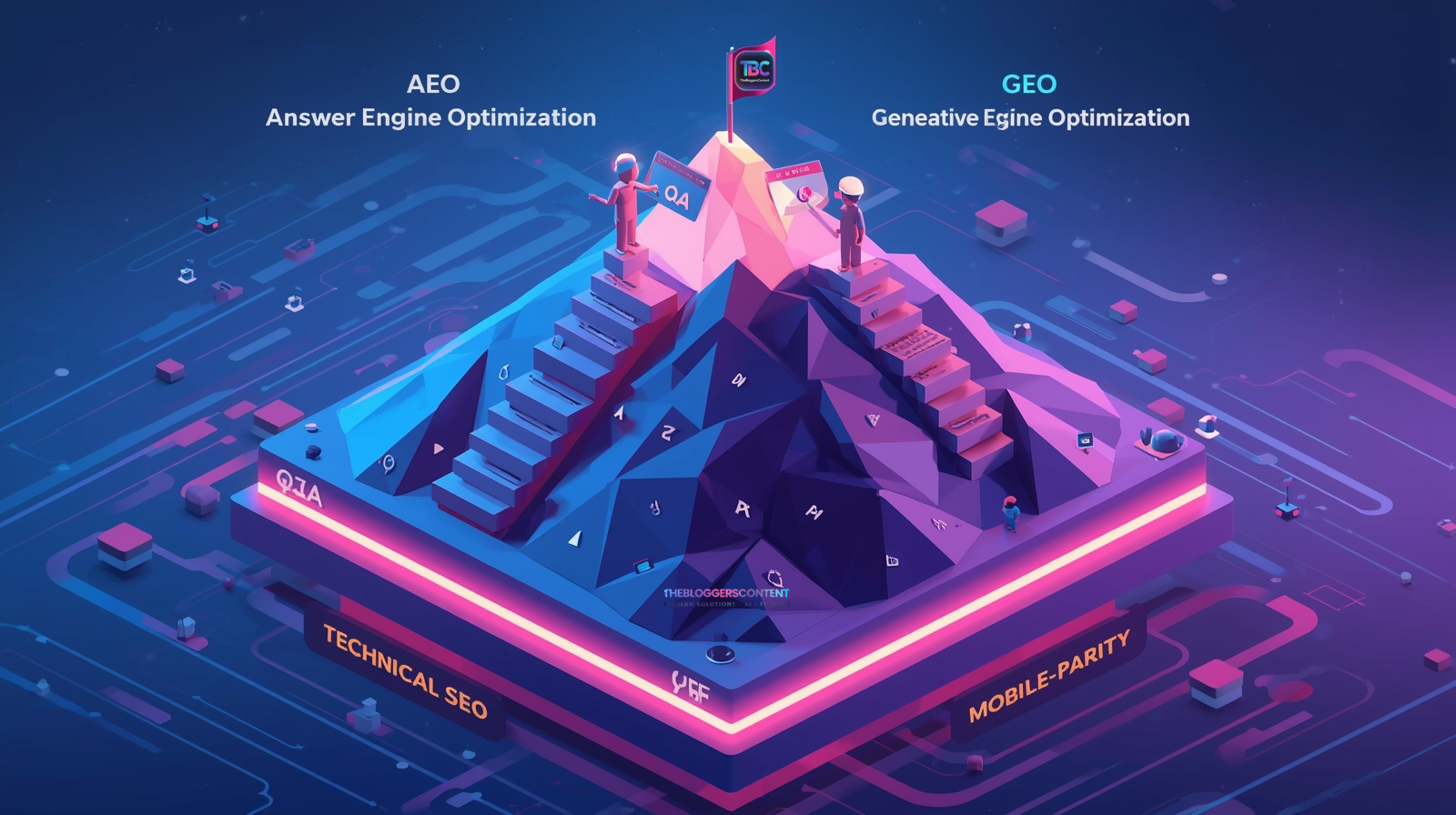
The Triple-Threat Strategy (SEO vs. AEO vs. GEO)
Traditional SEO: The Plumbing
SEO is the "plumbing" that ensures your site is discoverable. It remains the backbone because if an AI can’t crawl your site, it can’t summarize you.
- The Goal: To win the click from users who want a "deep dive."
- The Focus: Site speed (Core Web Vitals), clean HTML, and a logical structure.
2. AEO (Answer Engine Optimization): The Format
AEO is about speed and precision. It targets the "Answer Engines"—surfaces like Siri, Alexa, and Google’s AI Overviews (formerly SGE).
- The Goal: To win the "Answer Box" or "Position Zero."
- The Focus: Formatting. You need 40–60 word "Answer Blocks" directly under H2/H3 question headers. If you’re explaining , your first sentence must be: "Voice to Action AI is a system that [Definition]."
3. GEO (Generative Engine Optimization): The Signal
GEO is the newest and most critical frontier. It isn’t about ranking; it’s about Synthesis.
- The Goal: To get your brand mentioned, cited, and recommended within the generated responses of LLMs.
- The Focus: Information Gain. AI models prioritize content that provides unique data or perspectives they haven't seen elsewhere.
The GEO Deep-Dive – How to Get Cited by AI
This is where the game is won in 2026. Generative Engine Optimization is the process of making your content "irresistible" to a Large Language Model (LLM).
1. The "llms.txt" File: The New Sitemap
Just as we used robots.txt for Google, we now use yourdomain.com/llms.txt.
- What it is: A Markdown file in your root directory that provides a simplified, text-only map of your site’s most important facts.
- Why it works: It allows AI crawlers to summarize your brand accurately without getting lost in your JavaScript or CSS.
2. Information Gain & Unique Data
AI models are trained on the "average" of the internet. To be cited, you must provide "non-average" inputs.
3. Semantic Structure (The AI Cheat Sheet)
AI engines break pages into individual passages. Every section must stand on its own.
- Front-Load the Answer: Use the "Inverted Pyramid" style. Answer first, context second.
- Tables & Lists: AI models are 40% more likely to cite content that is presented in a structured table or bulleted list because it's easier to parse into a response.
Synthetic Authority – Backlinks & Brand Mentions
In 2026, the concept of a "Backlink" has evolved into "Entity Recognition." Google and AI models now look at your "Digital Footprint" across the entire web.
The Power of Brand Mentions (Unlinked Authority)
An "unlinked mention" is when a high-authority site (like a tech news outlet or a popular Reddit thread) mentions your name or blog without a clickable link.
- The Pros: These act as "Implied Links." AI models see these mentions and realize your brand is an Entity that real humans trust.
- The Help: It increases your "Share of Model" (how often an AI mentions you). If people are talking about your on Reddit, AI assistants will start recommending them automatically.
Modern Backlinking: Quality over Quantity
Stop buying links. One link from a niche-relevant, authoritative site is worth 10,000 directory links.
The Step-by-Step:
- Primary Research: Create a data-rich post (like a survey or technical breakdown).
- Digital PR: Reach out to industry newsletters. If they quote your data, you get a high-tier mention and a link.
- Unlinked Mention Recovery: Use tools like to find who mentioned you. Reach out and politely ask them to turn that mention into a link for "better user navigation."
The "Branded Search" Loop
When people see your brand mentioned on or , they go to Google and search for your name specifically.
- Why it helps: A high volume of branded searches is the ultimate "Trust Signal." It tells the algorithm that you aren't just another blog—you are a destination.
The Professional Toolkit
| Tool | Primary Use | Why It’s Essential |
|---|---|---|
| Ahrefs | Backlink Analysis & Site Audit | The gold standard for data depth. It helps you find high-value "link gaps" and fix technical issues that might prevent AI crawlers from indexing your site. |
| Semrush | Keyword Research & Competitive Intelligence | A massive historical database that tracks how your competitors are pivoting. Excellent for identifying the specific phrases that trigger AI-generated summaries. |
| Google Search Console | Performance & Indexing | The most trustworthy source of truth. It’s the only way to see exactly how Google views your sitemaps and which pages are gaining traction in search. |
| Perplexity AI | GEO Benchmarking | Essential for the new "GEO" era. Use it to see if your content is being cited as a source in AI answers, allowing you to tweak your authority signals. |
| AnswerThePublic | Intent & AEO Research | Visualizes the "Who, What, Why" questions people ask. Perfect for mapping out the conversational content needed to win in voice search and AI snippets. |
| Schema App | Structured Data Automation | For SEO in 2026, Schema isn't optional. This tool ensures your site speaks "machine language" fluently, making it easier for LLMs to parse your data. |
| Ubersuggest | Accessible SEO Insights | A veteran tool that simplifies complex data. Great for quick daily tracking and finding "low-hanging fruit" keywords that larger tools might overlook. |
Quick Access: SEO Tools
AnswerThePublic
Programmatic SEO 2.0 – Scaling Without the Spam
In 2025, many people tried to scale by generating 10,000 generic pages with AI. They were wiped out in the March 2026 Core Update. Programmatic SEO (pSEO) in 2026 isn't about volume; it's about Dynamic Precision.
The Data-First Framework
Instead of starting with a keyword, start with a Unique Dataset. If you have a list of tools, pricing data, or niche-specific stats (like your own internal tests from ), you can build templates that populate this data into high-value pages.
- The Keyword Pattern: [Tool A] vs [Tool B] for [Specific Use Case]
- The Scale: One high-quality template + 500 rows of data = 500 pages of high-intent traffic.
Adding the "Human Layer" to Automation
Google’s AI now looks for the "Hidden Gems"—sections of a page that show a human actually touched the content.
- Dynamic Summaries: Use LLMs to generate a unique, human-like introduction for every programmatic page based on the row data.
- Entity Clustering: Ensure your pSEO pages link back to your "Pillar Content" (like your ). This prevents them from being seen as "thin" or "orphaned" pages.
Advanced Technical SEO – The "AI-Only" Files
We’ve talked about schema, but 2026 introduces a new layer of technical communication specifically for the bots.
The llms.txt Manual
This is the single most important technical addition for 2026. Just as robots.txt guides Google’s crawler, llms.txt guides AI models (Gemini, ChatGPT, Claude) on how to summarize you.
- Location: Always at yourdomain.com/llms.txt.
- Structure: Use Markdown. Start with a # Site Name and a > One-sentence mission statement.
- The Content: List your top 5–10 authoritative pages (like your guide on ) with a one-sentence description. This acts as a "Cheat Sheet" for AI summarizers, ensuring they don't hallucinate your brand details.
The Semantic Knowledge Graph
Go beyond simple JSON-LD. Use "DefinedTerm" and "Mentions" schema to explicitly link your content to recognized entities.
Example: If you mention "Next.js," your schema should point to the official Next.js Knowledge Graph entity. This tells Google exactly where your expertise fits in the global web of information.
Visual & Multimodal SEO – Search What You See
In 2026, over 40% of searches are now multimodal—users pointing their cameras (Google Lens) or asking questions about a video.
The Video Transcript Loop
AI engines now "watch" your videos. If you have a video on your blog (like a tutorial for ), ensure you provide a high-fidelity, time-stamped transcript.
- Why it works: Search engines use these transcripts to generate "Video Chapters" directly in search results, capturing users before they even click.
High-Fidelity Image Optimization
Stop using stock photos. AI recognition tools (like Pinterest Lens) are now smart enough to detect "Generic Stock #42."
- Strategy: Use original, high-res images with descriptive, entity-rich Alt Text.
- The Result: You don't just rank in Google Images; you rank in the "Visual Discovery" feeds of AI assistants.
The "Behavioral Signal" Final Audit
The algorithm in 2026 is obsessed with Intent Fulfillment. It tracks what a user does after they click your link.
| Signal | Success Metric | How to Fix It |
|---|---|---|
| Pogo-sticking | User hits "Back" immediately | Your H1 doesn't match the search intent. Be more direct. |
| Scroll Depth | User reads 70%+ of page | Use "Bucket Brigades" (short, punchy sentences) to keep them moving. |
| Internal Click-Through | User visits 2+ pages | Use the "Sticky" internal linking we discussed in Part 1. |
| Branded Search | User types your name into Google | Build authority on or first. |
The Future is Systems, Not Hacks
The winners of 2026 are the ones who build scalable authority. You don't need to write 100 blogs a month; you need to build a system where your technical SEO, your AI-ready files (llms.txt), and your "Synthetic Authority" work together. You have the blueprint. Now, it's time to build the engine.